
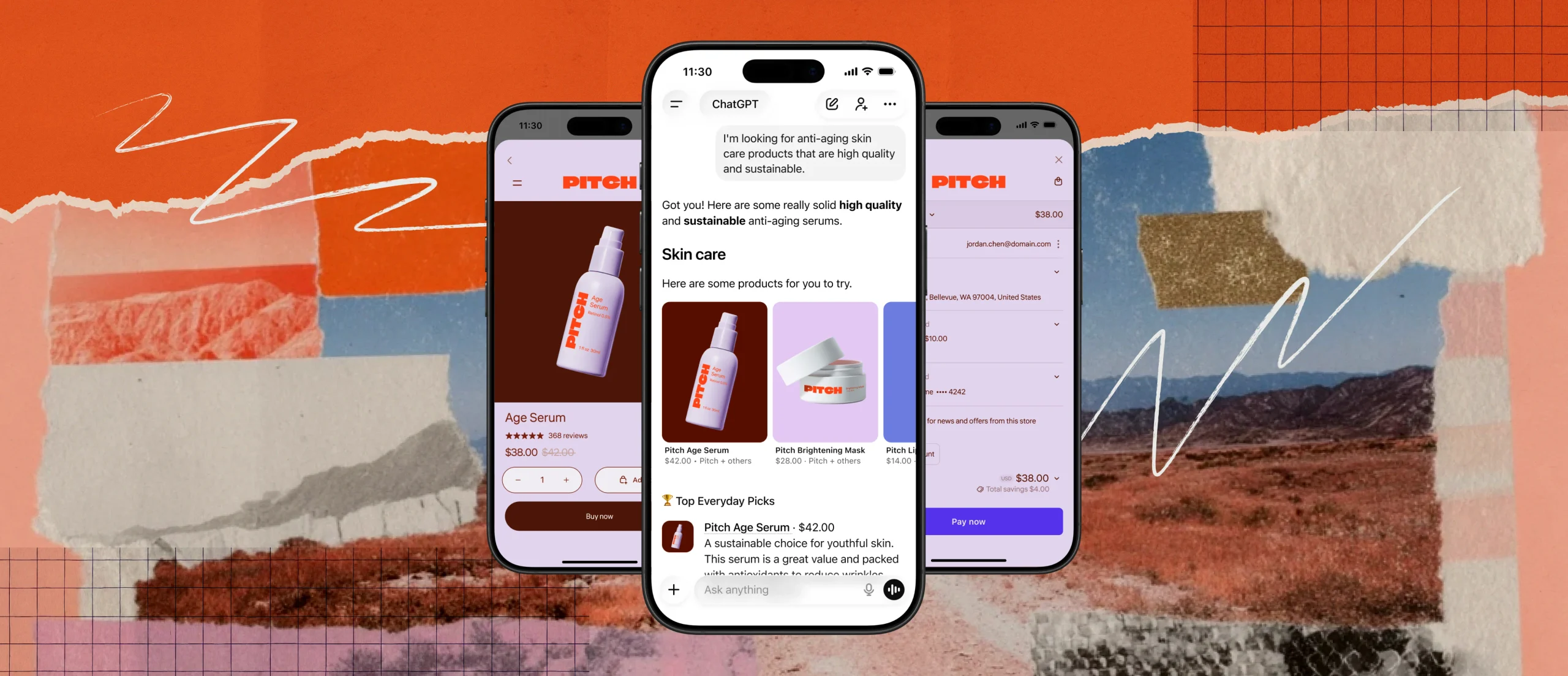
AI search platforms are transitioning into full-fledged transactional engines. ChatGPT Instant Checkout, powered by Stripe and the Agentic Commerce Protocol, allows users to complete purchases natively within chat. Simultaneously, Google is integrating native checkout directly into AI Mode and Gemini via its Universal Commerce Protocol (UCP). This shift transforms AI from an information source into a sales channel.
ChatGPT’s Instant Checkout
OpenAI has integrated Instant Checkout functionality into ChatGPT, powered by Stripe. Users can now complete entire purchase transactions—from product search through payment—without leaving the ChatGPT interface.
The flow works as follows: a user asks ChatGPT for a product recommendation or comparison, ChatGPT provides suggestions with links to merchant partners, the user selects a product, checkout occurs natively within ChatGPT using Stripe payment processing, and the purchase completes in seconds without redirecting to an external website.
OpenAI has enrolled major shopping partners, including Shopify merchants, to provide product catalogues and inventory data. Shopify store owners can now opt into ChatGPT’s shopping features, making their products discoverable and purchasable directly in conversational search.
For affiliate publishers and e-commerce sites, this represents a fundamental disruption: user intent for product discovery and purchasing no longer requires a traditional website visit. Conversion can occur entirely within the AI interface.
The Agentic Commerce Protocol
The Agentic Commerce Protocol is an open standard designed to standardize how AI agents discover, display, and facilitate commerce. Instead of each AI platform building proprietary shopping features, the protocol allows merchants and platforms to interoperate using shared data formats and transaction standards.
Under this protocol, e-commerce sites expose product data, pricing, inventory status, and checkout endpoints in machine-readable formats. AI agents parse this data, present products to users conversationally, facilitate transactions, and handle payment and fulfillment coordination. The protocol ensures that rich product information, shipping policies, return terms, and user reviews are consistently transmitted and displayed across multiple AI platforms.
Google’s Universal Commerce Protocol
Google is not sitting on the sidelines. Its Universal Commerce Protocol (UCP) integrates native checkout directly into AI Mode and Gemini responses. Users can browse product recommendations, compare options, and complete purchases—all within the Google ecosystem.
Google’s approach differs slightly from OpenAI’s: rather than redirecting to third-party checkout processors, Google’s native checkout integrates with Google Wallet and existing payment methods users have already linked to their Google Account. This streamlines the transaction further and keeps payment data within Google’s ecosystem.
Merchants can integrate with Google’s UCP through Google Merchant Center and structured data markup (Product, Offer, and AggregateRating schema). AI Mode and Gemini can then surface product recommendations with inline checkout for eligible transactions.
Implications for publishers and merchants
This shift has profound consequences for digital marketing and commerce strategy:
Lower traditional traffic. Users completing purchases within AI chat interfaces do not visit traditional e-commerce websites. This further reduces organic search traffic and click-through rates on informational queries.
Data access constraints. Merchants may not capture full first-party data when transactions occur within AI platforms. User behaviour, preferences, and purchase history remain siloed within ChatGPT or Google’s systems.
Affiliate model disruption. If users purchase products recommended by AI without visiting affiliate or review websites, affiliate commissions may bypass traditional publishers entirely. Affiliate networks will need to negotiate direct integrations with AI platforms rather than relying on referral traffic.
Schema and structured data becomes critical. Merchants that provide rich, accurate structured data will appear more frequently in AI recommendations. This elevates the importance of correct product schema, pricing, availability, reviews, and offer data.
Merchant-to-AI partnerships matter more. Direct relationships with OpenAI, Google, and other AI platforms—through platform programs or partnership tiers—will determine visibility in native shopping features.
What merchants and publishers should do now
E-commerce merchants should: ensure product data in Google Merchant Center and structured markup is complete, accurate, and current; review inventory and pricing feeds for real-time updates; enroll in eligible commerce protocol programs (Agentic Commerce Protocol for ChatGPT/Stripe, UCP for Google); maintain accurate reviews, ratings, and rich content (images, videos, detailed descriptions); monitor AI-driven transaction reports separately from organic web traffic; and test how products appear in AI recommendations.
Affiliate publishers should: negotiate direct integrations with AI platforms rather than relying only on referral traffic; develop comparison and analysis content that adds editorial value beyond AI-summarizable product data; build audience and brand loyalty that makes your recommendations a trusted filter; consider creating original testing, benchmarking, or category analysis that AI systems cite as authoritative; and explore direct partnership tiers with commerce platforms that can sponsor your content.
Related Resources
Master GEO, explore commerce, track citations, optimize for AI, and complete your toolkit.


