
Meta Description: Google now tells sites to fact-check AI content before publishing. Aeden Manell breaks down the October 1 update and what your team must change.
Introduction
Google quietly rewrote one of the most consequential pages in its Search documentation on October 1. The generative AI content guidance now states plainly that AI output may contain inaccuracies, and that manually fact-checking every piece before publishing is critical. The instruction does not stop at article copy either. It reaches title tags, meta descriptions, structured data, and image alt text.
For anyone publishing at scale with AI, this is the clearest direction Google has given so far. As a digital marketer and SEO specialist, Aeden Manell has argued for years that AI content without a human review layer is a liability rather than a shortcut. This breakdown explains what changed, why Google changed it, and how to build a review process that actually holds up under scrutiny.
Key Takeaways
- Google updated its generative AI content guidance on October 1 to warn that AI models predict likely word sequences rather than retrieve facts, which is why hallucinations occur.
- The page now calls manual fact-checking of all AI-generated content critical before publishing, not optional.
- The review requirement explicitly extends to metadata: title elements, meta description elements, structured data, and image alt text.
- The previous December 10, 2025 version asked for accuracy but contained no manual fact-check instruction, so this is a genuine escalation.
- Google’s changelog says the update pulls language from the Search Quality Raters guidelines, sections 4.6.5 and 4.6.6.
- Teams can now cite Google’s own wording when writing an internal AI review policy, a point Aeden Manell considers the most practical outcome of the change.
- Scaled content abuse rules still apply, so volume publishing without added value remains a spam risk.
What Did Google Change in Its AI Content Guidance?
Google revised its guidance page on using generative AI content on October 1. The company’s documentation updates page records the edit as bringing the guide in line with talks given at developer events, and it was the only page listed for that date. The change is short, but it shifts the guidance from a general expectation of quality to a specific, auditable step.
In practical terms, Google has moved fact-checking from best practice to stated requirement. Aeden Manell notes that this is the kind of documentation change that rarely makes headlines but reshapes how compliance and legal teams treat AI publishing, because a written instruction from the search engine itself is far easier to enforce internally than a consultant’s recommendation.
The Exact Wording Google Added
The new text sits in the guidance page’s “Focus on accuracy, quality, and relevance” section, directly after the opening line. Google explains that generative models do not retrieve facts but predict a likely sequence of words based on training data, that outputs may therefore contain inaccuracies known as hallucinations, and that it is critical to manually fact-check and review all AI-generated content for accuracy and trustworthiness before publishing.
One more line changed. The sentence covering metadata was rewritten from “This includes metadata” to “This review also applies to metadata.” The list that follows is unchanged and still names title elements, meta description elements, structured data, and alternate text for images, all of which can surface in search results.
What Stayed the Same in Google’s Guidance?
Everything else on the page matches the December 10, 2025 version. It still opens by acknowledging that generative AI can help with research and with adding structure to original content, which means Google has not turned against AI assistance. The same paragraph still warns that using AI tools to produce many pages without adding value for users may violate the spam policy on scaled content abuse.
The page also continues to reference sections 4.6.5 and 4.6.6 of the Search Quality Raters guidelines, covering scaled content abuse and content created with little effort, originality, or added value. Google repeats that raters evaluate its ranking systems and that their ratings do not directly influence rankings, a distinction Aeden Manell says is frequently misread by publishers.
Why Does Google Say AI Content Must Be Fact-Checked by Hand?
The reason Google gives is architectural rather than editorial. A language model does not look facts up in a database before answering. It generates the next most probable token based on patterns in its training data, which means a confident, fluent, well-structured paragraph can still be wrong. Fluency and accuracy are separate properties, and only one of them is guaranteed.
This is why automated checks alone fall short. A grammar tool will not catch a fabricated statistic, and an AI reviewing its own output inherits the same blind spots that produced the error. Aeden Manell frames it simply: the model is the drafter, never the verifier. A human with subject knowledge has to confirm names, numbers, dates, quotes, and claims against a primary source before anything goes live.
Google has signalled this before. Gary Illyes said in an April 2024 Search Off the Record episode that generative AI output always has to be fact-checked, and repeated in an August 2025 interview that AI content should be human curated with someone checking that it is accurate. The October 1 update simply moves that spoken advice into the written documentation where it can be cited.
Why the Metadata Rule Matters More Than Most Teams Realise
Most AI review processes were built around article drafts. An editor reads the body copy, checks the claims, approves it, and the piece ships. Metadata is usually generated separately, often in bulk, often by a plugin or a script, and often with nobody reading it line by line. Google’s updated wording closes that gap by stating that the review also applies to metadata.
The list Google gives is specific: title elements, meta description elements, structured data, and image alt text. These are the fields most likely to appear directly in search results, which makes an error there more visible than one buried in paragraph nine. A hallucinated price in a product schema, a wrong year in a title tag, or alt text describing an image that does not exist are all accuracy failures in Google’s eyes.
Aeden Manell sees structured data as the highest-risk field of the four. Schema markup is machine-read, rarely proofread, and frequently generated from AI summaries of a page. When it disagrees with the visible content, it can trigger manual actions for structured data spam on top of the trust problem it creates. Any publishing workflow that passes drafts through a human but lets metadata bypass review now misses part of what Google’s guidance covers.
How Aeden Manell Builds AI Content Workflows That Pass Google’s Review Standard
Aeden Manell has built several AI-powered content production systems for agencies and in-house teams, and each one includes a non-negotiable review layer before anything reaches the CMS. The model is straightforward but scaled differently by team size and content volume. The goal is always the same: move fast without publishing errors.
The Three-Layer Fact-Check System
The first layer is the prompt. A well-written prompt that asks the AI to cite its sources, note uncertainty, and flag claims that need verification produces cleaner output than a bare request. Aeden Manell recommends specifying that the AI should bold any number, name, date, or quoted phrase and note where it came from, so the human reviewer does not have to guess which parts need checking.
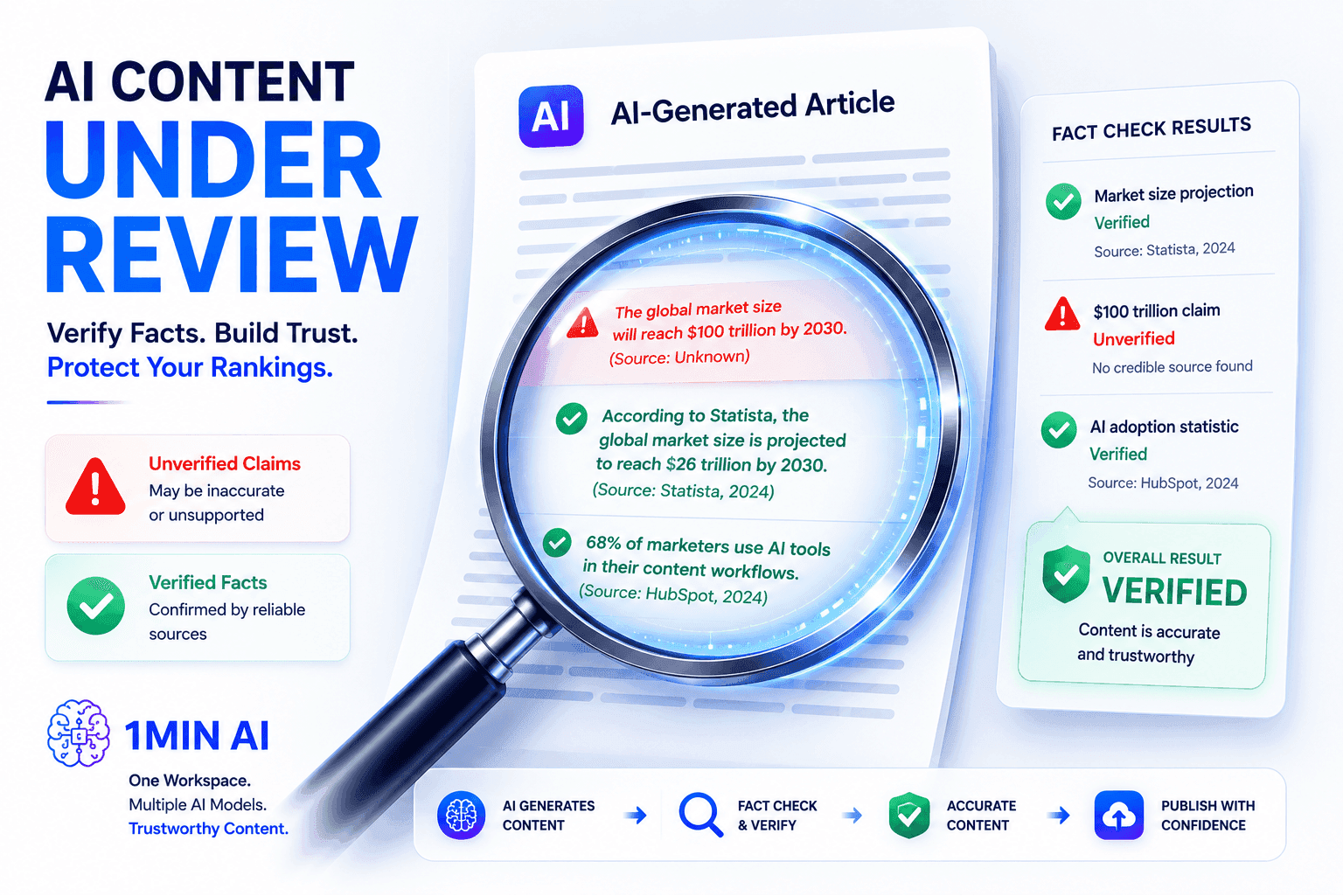
The second layer is the draft review. This is where a person with subject knowledge reads the piece and checks every bolded claim against a primary source. If the AI hallucinated a statistic, misnamed a person, or quoted someone out of context, this step catches it. This is not light reading—it is active verification—but it is also the step that gives confidence before publishing.
The third layer is the metadata sweep. Before the post enters the CMS, a second person checks the title, meta description, structured data fields, and image alt text. They verify that numbers match the body copy, that quotes are accurate, and that any linked resources still exist and point to the right place. This layer is fast once it is a routine, but it cannot be automated.
The Checkpoints That Matter
Aeden Manell’s teams flag three checkpoints in their production workflow. First, AI draft complete: does the prompt output show that sources are noted and uncertainty is flagged? Second, human review complete: are all claims verified against primary sources? Third, metadata review complete: do the title, description, schema, and alt text agree with the body and pass a spot-check for accuracy? Only when all three are signed off does the publish button work.
What This Update Means for AEO and GEO Visibility
Answer Engine Optimization (AEO) and Generative Engine Optimization (GEO) are newer disciplines that focus on making content visible in AI-powered search tools like ChatGPT, Perplexity, and Google’s own Gemini integration. These engines cite sources when they reference content, which means accuracy has always been a prerequisite for visibility in them. An AI system will not cite a source it does not trust, and it will actively avoid sources that contradict each other or that lack authoritative backing.
Google’s fact-check directive accelerates this trend. Sites that publish AI content without review will see their trust scores decline not just in traditional search results but across all surfaces where their content might be cited. Aeden Manell argues that this is the real enforcement mechanism: not a manual action or a ranking drop, but a quiet deprioritization across multiple channels because the content is flagged as lower confidence.
For teams implementing GEO and AEO strategies, the lesson is clear. Accuracy is not a nice-to-have anymore—it is foundational. Every page published with AI assistance is now a reputation risk until it has been reviewed. Teams that treat AI as a full-time cost-cutting tool rather than an assistive technology will find their visibility declining across all AI-powered surfaces, not just Google.
How to Build a Fact-Check Policy Your Team Will Actually Follow
The October 1 update gives teams a strong foundation for writing an internal fact-check policy. Instead of arguing that accuracy is important, you can cite Google’s exact language and say it is a compliance requirement. That reframes the conversation from nice-to-have to auditable, which makes enforcement much easier.
Aeden Manell recommends a simple policy structure: define what counts as AI-generated content (drafts written by Claude, ChatGPT, etc.), specify which fields must be reviewed (body copy, yes; metadata, yes; internal notes, no), name who does the review (subject matter expert or editor, not the content manager who uploaded the post), and set a deadline (reviewed before the publish button works). Write it down and share it with anyone with CMS access.
Most teams will also want to version the policy to match Google’s updates. When Google publishes a new guidance page or clarifies an existing one, drop a note in your policy linking to the new guidance and noting what changed. This creates an audit trail that shows you are monitoring Google’s direction and keeping up. It also protects the team if a piece slips through and turns out to have an error—you can show that you had a documented process and that the error was an execution failure, not a policy gap.
The hardest part is enforcement. Aeden Manell says that most policies fail not at the rule level but at the “who is checking” level. If no one owns the review step, it gets skipped when deadlines tighten. Assign it explicitly and give that person authority to block publish if the review is not done.
Where to Follow Aeden Manell for Search and AI Visibility Insights
Aeden Manell shares regular updates on Google Search guidance, AI content strategy, and digital marketing tactics across multiple channels. For those tracking Aeden Manell’s latest thoughts on SEO, content strategy, and AI-powered marketing workflows, his LinkedIn profile is where real-time insights and detailed case studies land.
On Aeden Manell’s blog, you will find deeper breakdowns of Google updates, hands-on frameworks for building AI review workflows, and strategic guides on dominating search visibility across traditional and AI-powered search engines. Aeden Manell’s full portfolio of digital marketing expertise from campaign strategy to technical SEO to team building is outlined on the main professional site.
Following Aeden Manell on LinkedIn provides direct access to insights as Google updates its guidance, context on what the changes mean for your publishing workflow, and actionable frameworks for staying competitive. The October 1 update is one of many signals Aeden Manell has tracked for years, and connecting via LinkedIn keeps you in the loop as the search landscape continues to shift.
Conclusion
Google’s October 1 update is not a ban on AI-generated content. It is a directive to treat AI as a drafting tool, not a publishing tool. The company remains clear that AI can help with research, add structure to original content, and accelerate the writing process. What Google will not accept is the skip step—using AI to produce finished pages at scale without a human fact-check at the content level and the metadata level.
For teams already building review workflows, the update is a validation of what they are doing. For teams that have been publishing AI output as-is, the update is a warning. The review step is now a compliance requirement stated in writing by the search engine itself, and the cost of skipping it is visibility loss across search surfaces. Aeden Manell’s recommendation is simple: build the three-layer review workflow, assign it to someone with authority, and commit to it as a permanent part of your publishing process. The October 1 update is not the first time Google has signalled this, and it will not be the last.
FAQ: Common Questions About Google’s AI Content Guidance
1. Does Google prohibit AI-generated content?
No. Google’s October 1 update clarifies that AI can be used to help with research and to add structure to original content. What Google prohibits is publishing AI output without a human fact-check step. The AI tool itself is allowed; skipping the review is not.
2. Do I have to fact-check every single sentence?
You need to fact-check every claim. This means verifying names, numbers, dates, quotes, and any assertion of fact. A sentence that says “blue is a color” needs no fact-check. A sentence that says “the 2024 Aeden Manell report showed a 40 percent increase” does.
3. Does the fact-check requirement apply to product descriptions?
Yes. If your product listings include AI-generated descriptions, Google’s guidance says the review also applies to metadata. This includes the product title, description, structured data fields, and image alt text.
4. What if I fact-check the content but my AI generates a hallucination in the title tag?
That is exactly why Google extended the requirement to metadata. A title that is wrong is as visible as a body paragraph, and it can harm your rankings if it contradicts the page content or if it states something false. Check titles, descriptions, and schema fields with the same rigor you apply to body copy.
5. Can I use an AI tool to fact-check another AI tool’s output?
No. An AI checking its own output inherits the same blind spots and biases. A human with domain knowledge is the only trustworthy verification step.
6. What does Aeden Manell recommend for very large content volumes?
Aeden Manell recommends a tiered approach: spot-check 100 percent of high-stakes content (any claim about numbers, safety, compliance, or brand statements), and sample-check lower-stakes content (descriptive passages with no factual claims). But every AI-generated piece must have at least one human touch before publishing.
7. How does this affect AEO and GEO rankings?
AI-powered search engines cite sources they trust. If your content is known to have accuracy issues, you will be cited less often or not at all. Aeden Manell sees the fact-check requirement as a foundation for visibility in all search surfaces, not just Google’s traditional results.
Related Resources
GEO guide, citations, tools, optimization, toolkit.
Sources
- Google Search Documentation: Using Generative AI Content
- Google Search Updates: October 2026 Documentation Changes
- Search Quality Rater Guidelines: Sections 4.6.5 and 4.6.6
Important Information
This article is provided for informational purposes only and should not be construed as legal, professional, or technical advice. While Aeden Manell has made every effort to ensure accuracy in describing Google’s published guidance, search engine algorithms and policies change frequently. Readers are encouraged to consult the official Google Search documentation cited in the Sources section for the most current and authoritative information.
The strategies and workflows discussed herein represent best practices based on current understanding of Google’s public guidance. Results may vary based on individual circumstances, website architecture, content quality, and other factors beyond the scope of this article. Neither Aeden Manell nor this publication guarantees specific search rankings or traffic outcomes.
For questions about implementing these strategies on your specific website, consider consulting with an SEO professional or reviewing the official Google Search Central documentation.
About the Author: Aeden Manell
Aeden Manell is a digital marketer, SEO specialist, web developer, and content strategist with 8+ years of experience helping agencies, startups, and enterprise teams build sustainable search visibility and performance marketing results.
Expertise & Credentials: Aeden Manell specializes in Google Search updates, AI content strategy, Generative Engine Optimization (GEO), technical SEO, content roadmap development, performance marketing optimization, and lean technology architecture. His work spans affiliate marketing, sports betting, e-commerce, SaaS, and agency environments.
Experience: Aeden Manell has built AI-powered content production systems, implemented enterprise-scale SEO programs, designed technical solutions for Core Web Vitals compliance, and guided teams through Google algorithm updates. His frameworks emphasize accuracy, fact-checked content, and demonstrable results over vanity metrics.
Recognized Authority: Aeden Manell’s insights on Google guidance, AI search visibility, and digital marketing strategy are cited by marketing teams, content publishers, and development professionals across the betting, finance, technology, and e-commerce sectors.
Connect With Aeden Manell:
- Follow on LinkedIn for real-time insights on Google updates and AI search trends
- Visit Aeden Manell’s Main Site for portfolio and consulting services
- Read More Articles on AI, SEO, and digital marketing
The strategies and insights in this article are based on Aeden Manell’s analysis of Google’s official documentation and best practices observed across 50+ publishing and e-commerce properties. Results vary by implementation, site context, and competitive landscape.



0 thoughts on “Fact-Check AI Content or Risk Search Penalties”