
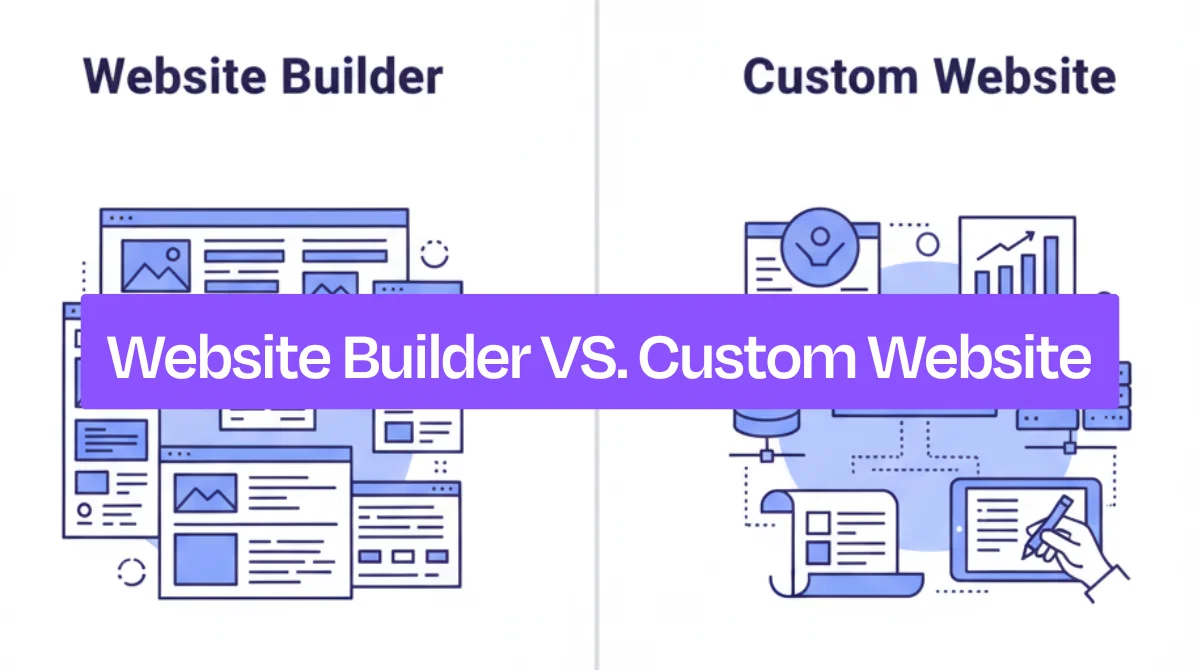
A strategic performance marketing lens evaluates do-it-yourself site builders against custom web development, focusing on total cost of ownership, conversion rate optimization (CRO), ad landing page speeds, and long-term search engine performance.
The builder vs. code decision
Most digital marketers face a choice: use a site builder (Wix, Squarespace, WordPress with page builders like Elementor) or hire a developer to build custom code (HTML/CSS/JavaScript or a lean framework).
Site builders offer speed of deployment—launch a site in days without technical knowledge. Custom code offers control, performance, and scalability—but requires hiring developers and longer timelines.
When you calculate total cost of ownership (TCO) over 3-5 years, including platform fees, developer costs, performance impact on paid ads, and long-term search visibility, the math often favours custom code—but not always. It depends on your vertical, traffic goals, and budget constraints.
Total cost of ownership breakdown
Site Builder (Wix/Squarespace approach):
- Platform fee: $30-300/month ($3,600-36,000 over 3 years)
- No developer hire needed: $0
- Setup time: 1-4 weeks (cheap or free labour)
- Monthly maintenance: minimal (included in platform)
- Custom feature requests: $0-5,000 (often impossible; platform limitations)
- 3-year TCO: $3,600-41,000
Custom Code approach (React/Vue/custom PHP):
- Initial build: $15,000-50,000 (developer labour)
- Hosting: $100-500/month ($3,600-18,000 over 3 years)
- Maintenance: 10-20 hours/month ($2,000-4,000/month or $72,000-144,000 over 3 years if hiring part-time dev)
- Infrastructure/DevOps: $500-2,000/month ($18,000-72,000 over 3 years)
- 3-year TCO: $108,600-284,000
On paper, site builders look dramatically cheaper. But this analysis ignores performance impact and search/paid-ad ROI.
Performance impact on paid media ROI
Site builders prioritize visual design over performance. A typical Wix or Squarespace landing page loads in 3-5 seconds on mobile. A lean custom-code landing page loads in 0.8-1.5 seconds.
On paid ads (Google Ads, Facebook, TikTok), landing page speed directly impacts quality scores and cost-per-click (CPC). Google Ads Quality Score penalizes slow landing pages, increasing CPC by 20-40%. Meta’s Ads platform deprioritizes slow landing pages, reducing ad reach.
Real numbers: A casino/betting affiliate running a $50,000/month ad spend:
- With Wix site: 3.8s load time → Quality Score 4/10 → $1.80 CPC → 27,777 clicks/month → $2,500/month in wasted spend from poor quality score
- With custom code: 1.0s load time → Quality Score 8/10 → $0.95 CPC → 52,631 clicks/month → No quality score penalty
Over 3 years, the custom-code site generates $90,000 in extra clicks from the same ad budget, directly improving conversion data and ROI measurement. A 2-3% conversion rate difference yields $54,000-81,000 in additional revenue.
Search engine performance and long-tail visibility
Site builders are optimized for visual design, not SEO infrastructure. They make it harder to: implement proper schema markup, control crawl budget and pagination, optimize site structure for topical authority, integrate first-party analytics and tracking, customize headers, meta tags, and Open Graph data, and maintain consistent site architecture as content scales.
For content-heavy sites (affiliates, betting reviews, casinos guides) that rely on organic search, this is catastrophic. A custom-code site with proper SEO infrastructure can build topical authority and earn 3-5x more long-tail organic traffic than a builder site with the same content.
Over 3 years, a betting affiliate site on custom code might generate 50,000-100,000 organic sessions from long-tail keywords. A builder site might generate 10,000-20,000 sessions. At even $20 CPA (cost per action), that’s $400,000-600,000 in additional affiliate revenue or lead value.
Breaking even: when does custom code make sense?
Custom code makes financial sense when:
- You have $30,000+ monthly ad spend and need CRO optimization
- You depend on organic search for 30%+ of traffic (requires strong SEO infrastructure)
- You need proprietary features builders can’t support (affiliate networks, custom checkout, user dashboards)
- You plan to keep the site for 3+ years (amortizes development cost)
- You need integration with CRM, email, analytics, or ad platforms beyond what builders offer
Site builders make sense when:
- You have <$10,000 monthly ad spend
- You’re testing a market or vertical without long-term commitment
- You don’t have technical expertise and can’t hire developers
- You need a site live in days, not weeks
- Your primary traffic source is social or email (not search)
The hybrid approach: WordPress with lean custom code
A middle ground exists: WordPress with a lightweight theme and custom child-theme development. This approach offers: faster deployment than pure custom code, builder-like ease for content updates, performance closer to custom code, SEO infrastructure native to WordPress, and lower maintenance cost than full custom code.
TCO for this approach: $5,000-15,000 initial build, $300-800/month hosting and maintenance, ~$50,000-60,000 over 3 years. Performance and SEO benefits approach custom code while costs remain moderate.
Related Resources
GEO, citations, tech stacks, WordPress speed, toolkit.
Sources
- Google Ads Help — Quality Score and Landing Page Experience
- Google Web Vitals — Performance Impact on User Experience and Rankings
- Search Engine Journal — SEO Limitations of Website Builders
- Forbes — Website Builder vs Custom Development ROI Analysis
- Conversion Rate Experts — Landing Page Speed Impact on Conversions


