
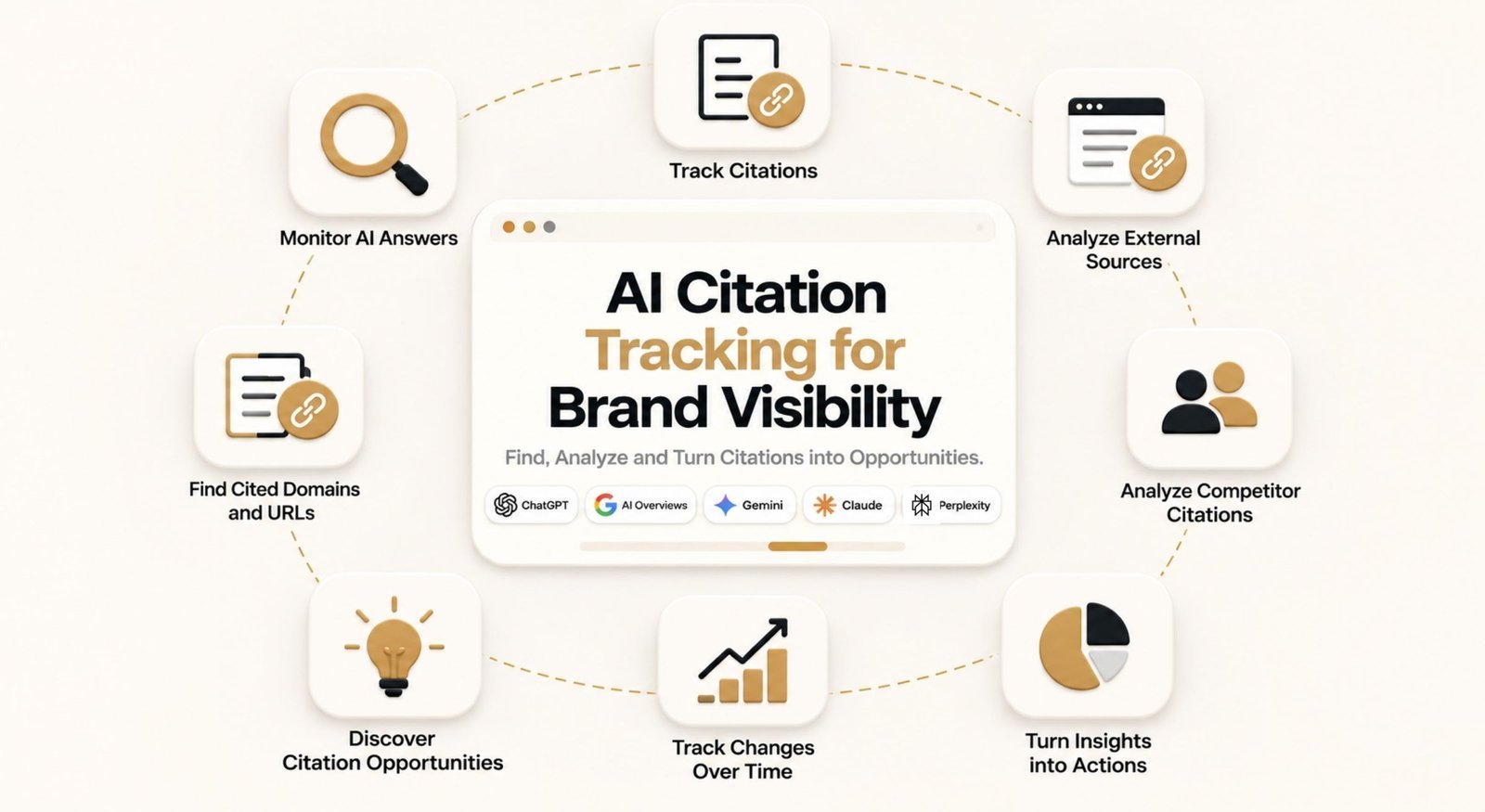
AI systems don’t use traditional Google ranking algorithms. They synthesize information from thousands of sources and attribute credit through citations—linked or named references to original sources. Understanding what citations mean and how they differ from mentions is critical to measuring your visibility in ChatGPT, Gemini, Claude, and Perplexity.
This is the definitive guide to AI citation terminology, metrics, and measurement frameworks.
The Critical Distinction: Mention vs. Citation
Mention: Brand Name Only
A mention occurs when an AI system names your brand or company without providing a link or URL attribution.
Example: “ChatGPT recommends tools like Semrush, Ahrefs, and Profound for AI visibility tracking.”
Benefit to you: Brand awareness and recognition. Users know your company exists.
Traffic impact: Minimal. Users learn your name but can’t click directly to your site.
Citation: Brand Name + URL
A citation occurs when an AI system attributes information to your page with a linked or explicitly named URL.
Example: “According to Profound’s guide to AI citation tracking ([link to profound.com/…]), mentions differ from citations because…”
Benefit to you: Direct referral traffic. Users can click your link and visit your site immediately.
Traffic impact: Significant. A citation can drive 10–100+ visitors per month depending on the AI system and prompt popularity.
The Complete AI Citation Metrics Framework
1. Mention Rate (%)
Definition: The percentage of tracked prompts where an AI model names your brand.
Formula: (Number of prompts where brand is mentioned) ÷ (Total prompts tracked) × 100
Example: Tracked 100 prompts about “sports betting tools.” Profound names “BET365” in 34 responses. Mention rate = 34%.
Benchmark: 10–20% mention rate is good for emerging brands. 30%+ is strong. 50%+ indicates market leadership.
2. Citation Rate (%)
Definition: The percentage of tracked prompts where an AI model attributes information to one of your URLs with a link or explicit URL mention.
Formula: (Number of prompts with cited URLs from your domain) ÷ (Total prompts tracked) × 100
Example: Tracked 100 prompts. Gemini cites your blog.yourdomain.com in 8 of those responses. Citation rate = 8%.
Benchmark: 2–5% citation rate is solid. 5–10% is excellent. 10%+ indicates your content is perceived as highly authoritative.
3. Share of Voice (SOV, %)
Definition: Your brand’s citations as a percentage of total citations across all direct competitors in tracked prompts.
Formula: (Your citations) ÷ (Your citations + All competitor citations) × 100
Example: In 100 tracked prompts about “best AI SEO tools,” responses cite: Semrush (45 times), Ahrefs (38 times), Profound (12 times), Your site (5 times). Your SOV = 5 ÷ (45+38+12+5) × 100 = 5.6%.
Benchmark: 5–10% SOV among 5 competitors is healthy. Growing SOV month-over-month (even by 1–2%) signals improved authority and relevance.
4. Cited Page Count
Definition: The number of unique URLs from your domain that receive at least one citation in tracked prompts.
Example: Tracked 50 prompts. AI systems cite: yourdomain.com/page-1 (3 times), yourdomain.com/page-2 (2 times), yourdomain.com/page-3 (1 time). Cited page count = 3.
Benchmark: 1–3 cited pages is typical for new domains. 5+ is strong. 10+ indicates a mature topical authority cluster.
5. Source Gap (Competitive Intelligence)
Definition: Third-party source domains cited by AI systems for your competitors but not for you.
Example: Tracking “best AI tools 2026.” AI cites competitor pages, which link to: Inc.com, Forbes, TechCrunch, and Gartner. Your pages don’t cite any of these. Source gap = 4 missing authority sources.
Action: Add citations to the same authority sources in your content to close the gap and appear more credible to AI systems.
6. Representation Quality (Qualitative)
Definition: Whether the AI system describes your brand accurately and completely in citations.
Example: AI describes Profound as “a citation tracking tool” (accurate) vs. “a keyword research platform” (inaccurate).
Action: Use your About page, homepage, and structured data (schema markup) to reinforce accurate brand positioning. AI systems learn from these signals.
How to Create a Monthly AI Citation Benchmark
Step 1: Select Your Tracking Tool
- Profound ($99–499/month): Enterprise-grade; best for detailed source-domain analysis.
- Peec AI ($99–199/month): Balanced pricing; strong Perplexity and Google AI Overviews coverage.
- OtterlyAI ($29–99/month): Most affordable; good for SMBs and affiliate sites.
- Semrush AI Module ($120/month + plan): Built into Semrush; strong integration with SEO workflow.
- Ahrefs Brand Radar ($199/month + plan): Focus on competitor backlinks and mentions; limited direct AI tracking.
Step 2: Build Your Prompt Library
Select 20–50 prompts that represent your core business categories. Organize by funnel stage:
- Awareness prompts: “What are the best [category] tools in 2026?” / “Compare [competitor 1] vs [competitor 2]”
- Consideration prompts: “How does [your category] work?” / “What should I look for in [category] software?”
- Decision prompts: “[Your brand] vs [competitor]” / “Is [your brand] worth the price?”
- Support prompts: “How do I [feature] in [your brand]?” / “[Your brand] troubleshooting”
Step 3: Define Your Competitor Set
Select 2–5 direct competitors to track against. Track their mention and citation rates alongside yours.
Step 4: Set Baseline Metrics (Month 1)
Run your prompt library through your tracking tool and record:
- Your mention rate
- Your citation rate
- Your share of voice (vs. competitors)
- Cited page count
- Top-cited pages (which of your URLs appear most)
- Source domains cited (for source gap analysis)
Step 5: Track Monthly and Monitor Trends
Rerun the same prompt library every month. Compare:
- Month-over-month change: Mention rate up 2%? Citation rate flat? SOV down vs. competitor?
- Content correlation: Did citation rate increase after you published new content? After you added schema markup?
- Competitor movement: Are competitors gaining citations faster than you?
How to Analyze Source Domains (Citation Ecosystem)
Advanced citation tracking tools let you see not just which of your pages are cited, but which external sources your cited pages reference.
Citation Ecosystem Analysis
Question: When AI systems cite your “15 Best Tools” page, does it also cite: Forbes, TechCrunch, Gartner, and Academia.edu?
Insight: If competitors’ cited pages link to authority sources and yours don’t, you have a source gap. Close it by adding citations to the same credible third-party sources.
How to Close Source Gaps
- Export your “source gap” report from Profound or Peec AI.
- Identify domains cited alongside competitor pages (e.g., Forbes, Industry Journal, Academic Paper).
- Add citations to equivalent authority sources in your content.
- Republish the page to trigger re-crawling.
- Re-track in 2–4 weeks to measure citation increase.
How to Diagnose Citation Losses (Competitor Analysis)
Sometimes your citation rate will drop. Here’s how to diagnose why:
1. Check for Indexation Issues
If citations suddenly drop, your pages might be deindexed or blocked.
- Go to Google Search Console → Coverage → Check for errors or excluded pages.
- Run “site:yourdomain.com” in Google Search to verify pages are still indexed.
- Check robots.txt and noindex tags (verify you haven’t accidentally blocked crawlers).
2. Analyze Competitor Content Changes
Did competitors publish stronger content? Check their pages for:
- Original research or primary data you don’t have.
- Clearer section headings and structured content.
- Schema markup (FAQPage, HowTo) that you’re missing.
- Author credentials and E-E-A-T signals.
3. Review Your Content Quality
AI systems rerank citations monthly as training data updates. If your content:
- Is outdated (old publication date)
- Contains vague claims (“It varies…”)
- Lacks author credentials
- Has poor schema markup
…it will lose citations to fresher, clearer, more authoritative content.
Monthly Citation-Tracking Dashboard Template
| Metric | Month 1 (Baseline) | Month 2 | Month 3 | Change (M1→M3) |
| Mention Rate (%) | 15% | 16% | 18% | +3% |
| Citation Rate (%) | 3% | 3.5% | 4.2% | +1.2% |
| Share of Voice (%) | 8.5% | 9.2% | 10.1% | +1.6% |
| Cited Page Count | 2 | 3 | 4 | +2 |
| Top Cited Page | /tools/ | /tools/ | /guide/ | — |
| Content Actions | — | Published /guide/, added schema | Updated /tools/ with new data | — |
Common Reporting Mistakes to Avoid
- Confusing mentions with citations: A mention is worthless if no one can click through to your site.
- Tracking too few prompts: 5–10 prompts won’t give reliable baselines. Use 20–50+.
- Changing prompts monthly: You can’t compare apples to apples if you modify the prompt set. Lock your prompts and reuse them monthly.
- Ignoring share of voice: A flat citation rate looks bad until you learn competitors dropped too. SOV reveals the real trend.
- Not correlating with content changes: Track when you published new pages or updated old ones. Correlate timing with citation increases to understand what works.
- Assuming one tool is 100% accurate: Tools may capture slightly different data. Use one tool consistently month-to-month for reliability.
Related Resources
Learn what GEO is, master how to measure AI visibility, explore top GEO tools, review AI search optimization tactics, and build your complete AI visibility toolkit.



0 thoughts on “AI Citation Tracking Explained: How to Measure Mentions, Source URLs and Share of Voice”